Pammachon Wellness
Medical texts from the 4th century A.D. in the Greek-speaking Eastern Roman Empire describe a form of shadow-boxing, characterized by unopposed fist movements performed in a dance-like manner. This practice was recommended to alleviate fatigue and reduce nervousness, with specific references to its benefits for kidney and intestinal ailments. The movements, known as “χειρονομίαι” (cheironomiae), included not only arm motions but also leg movements in the form of kicks. These exercises were deemed suitable for a wide range of individuals, including children, women, the elderly, and those who were ill. In modern times, the International Pammachon Federation has reconstructed eight distinct movements.
Sources:
1. ΚΟΥΖΗΣ Α. Ορειβασίου, Ιατρικαί Συναγωγαί προς Ιουλιανόν. Βασιλικόν Τυπογραφείον, Αθήνα, 1909.
2. AETII AMIDENI: Libri Μedicinalis IΙΙ, Corpus Medicorum Greacorum, 1534.
Foundation:
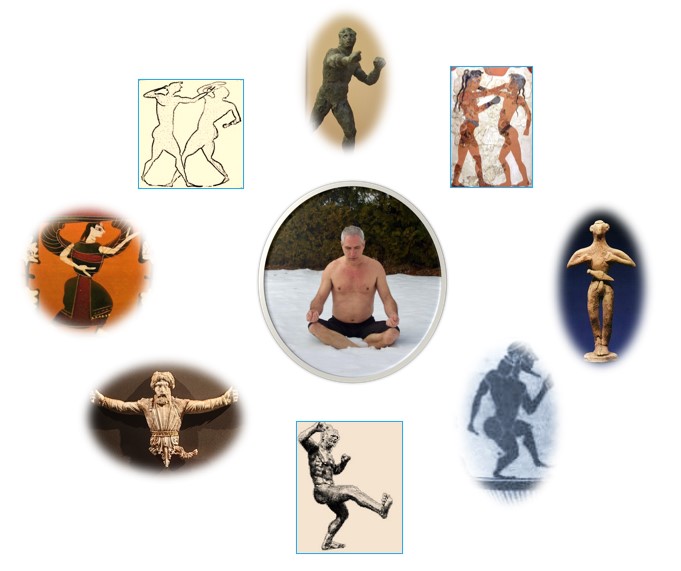
Eight movements and breathing derived from archaic/ancient ritual dance and combative kinesiology inherent to the thousands of years of Greek history.
Historical note: Ancient Hellenic figures are typically portrayed in the nude.
Νοῦς ἐστιν ὁ διακοσμῶν τε καὶ πάντων αἴτιος.
First movement:
Metis.
Metis was the archaic goddess of primal wisdom, the wisdom of the hunt, a quality that combined astuteness with cunning.
Second movement:
Internal cut.
The same movement may be executed with or without weapons.
Third movement:
External cut.